Ecosystem Stack for Tron by OpenZeppelin – Building Secure Foundations for Developers
Basic Information
Project Name: Ecosystem Stack for Tron
Project Track: infra-security
Team Name: OpenZeppelin
Social Info
X (Twitter): @OpenZeppelin
Website: https://www.openzeppelin.com
Project Overview
Project Goal:
Bring OpenZeppelin’s open-source smart contract libraries, developer tooling, and documentation to the TRON ecosystem, enabling developers to build and deploy secure, audited smart contracts on TRON with the same confidence as on Ethereum and other leading ecosystems.
Unique Value Proposition:
OpenZeppelin is the global leader in smart contract security and open-source standards, trusted by the Ethereum Foundation, Arbitrum, Polkadot, Stellar, and Starknet, and securing over $30 trillion in total value transferred since 2018.
With over 650 thousand Contracts Wizard users and 2.7 million yearly documentation views, OpenZeppelin provides the most widely adopted and battle-tested smart contract library in the industry.
By bringing these standards and tools to TRON, we aim to accelerate developer confidence and adoption, improve security, and strengthen the ecosystem’s position among leading blockchains.
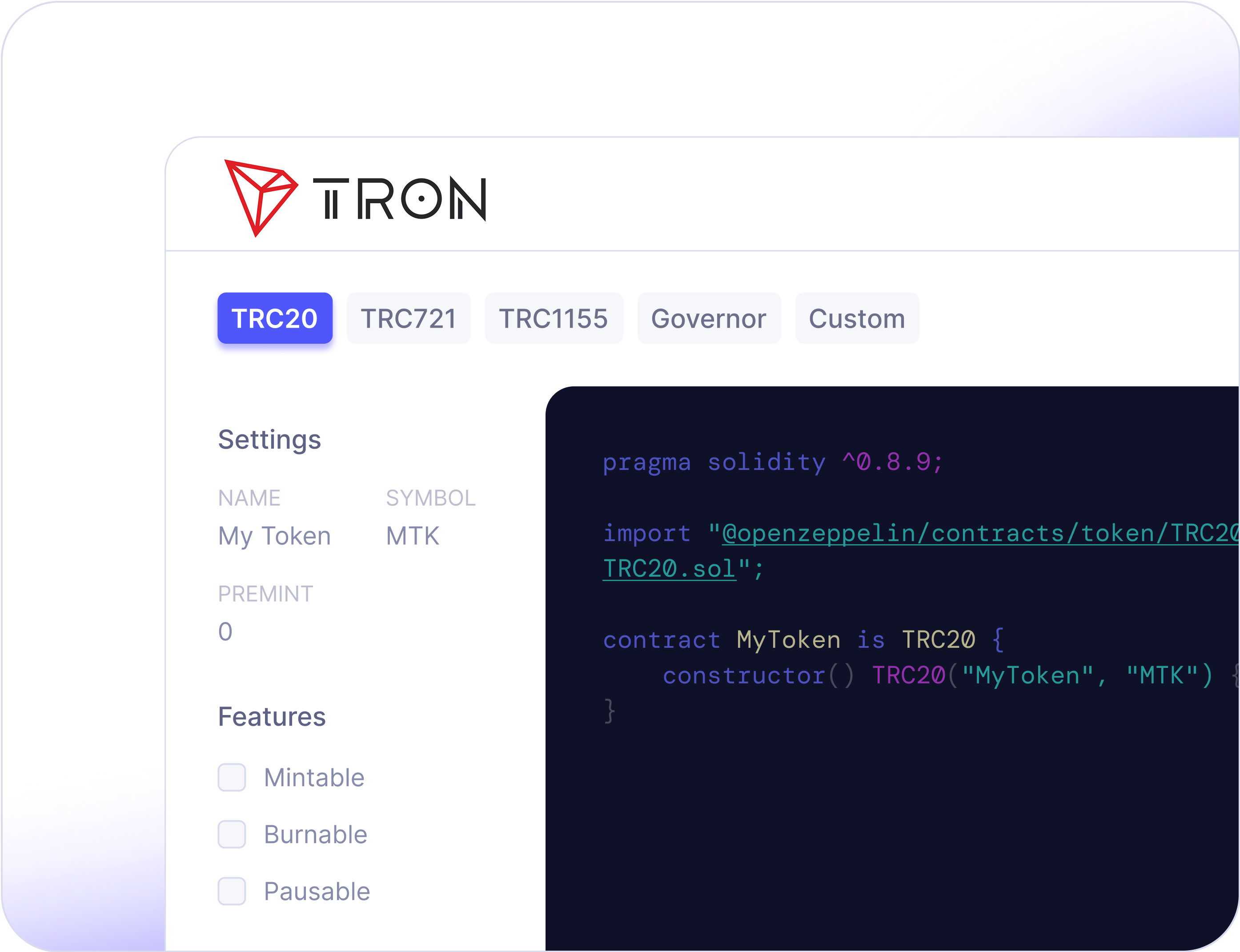
Illustrative example of OpenZeppelin Contracts Wizard customized for Tron.
Through this project, we will:
- Port, test, and ensure compatibility of the OpenZeppelin Contracts Library and Open Intents Framework (OIF) for TRON.
- Integrate TRON TRC contracts into the OpenZeppelin Contracts Wizard and Documentation.
- Add support for OpenZeppelin Upgrades Plugins in Hardhat and Foundry, contingent on TRON compatibility.
- Develop a new TronBox Upgrades Plugin within the OpenZeppelin Upgrades repository to ensure native integration with TRON’s toolchain.
- Drive developer adoption through tutorials, hackathons, and co-marketing initiatives.
Project Demo:
Repositories and live demos for TRON will be published progressively as milestones are completed. These updates will be included in public repositories, including but not limited to those listed below:
Expected Completion Date: All main releases will be completed by February 2026, with maintenance, support, and developer adoption efforts continuing through September 2026. Options for continued development and extended maintenance and support will also be available.
Current Progress (%): 0% (Kickoff pending)
Technical & Governance Details
Project Test Instructions:
Developers will be able to test the TRON-adapted OpenZeppelin Contracts and tools directly from public GitHub repositories.
All code will be open-source and will include automated test suites and documentation for TRC-compatible deployments.
Technical Details:
- Language: Solidity for TVM, TypeScript and JavaScript for tooling
- Scope: OpenZeppelin Contracts Library, Open Intents Framework contracts, Wizard integration, Documentation, and Upgrades Plugins support for Hardhat, Foundry and TronBox
- Testing: ≥90% code coverage, CI/CD pipeline integration, public PR reviews
- Audits: Smart contracts audited by the OpenZeppelin Security Research team
Smart Contract Links:
To be published in OpenZeppelin’s public repositories, including but not limited to:
How is the Project Governed?:
Centralized open-source governance under OpenZeppelin, with community contribution via GitHub pull requests and public release candidate reviews.
Funding & Business Model
Revenue Model:
Open-source public good for the TRON ecosystem; a grant will be required to support development and maintenance.
Interested in TRON Having a Stake?:
Yes, collaboration and ecosystem alignment will be maintained through biweekly syncs with the TRON core team, as well as coordination via GitHub issues and pull requests.
Preferred Collaboration Method:
Biweekly syncs, GitHub collaboration, and joint developer activations with TRON and its community.
Ecosystem Impact
Partnerships:
OpenZeppelin collaborates with leading ecosystems including Ethereum, Arbitrum, Polkadot, Stellar, Starknet, and Uniswap. We are now extending these standards and developer tools to TRON. Please refer to our dune-dashboards for metrics on our impact across these and other ecosystems.
Time on TRON:
Development begins upon approval by TRON’s core team.
Project Milestones
The following milestones and timelines assume project approval on October 2025.
Project Milestones:
| # | Milestone | Duration | Timeline | Description |
|---|---|---|---|---|
| 1 | Solidity Contract Libraries Support | 3 months | October 2025 –> December 2025 | Analyze the TRON Virtual Machine (TVM) architecture to identify possible Solidity incompatibilities caused by energy-based metering, modified opcodes, and custom precompiles. Review and test OpenZeppelin’s Solidity contracts (openzeppelin-contracts) alongside existing TRC implementations (TRC-10, TRC-20, TRC-721, etc.) to detect and resolve edge cases. Deliver a comprehensive guide with mitigation steps, and publish the first version of OpenZeppelin Contracts for TRON, ensuring compatibility with the Open Intents Framework (OIF) contracts (ERC-7683 and related standards) to support secure intent execution and cross-chain payments across networks. |
| 2 | Wizard & Documentation Integration | 1 month | January 2026 | Add a dedicated TRON section to the OpenZeppelin Contracts Wizard and Documentation, enabling developers to bootstrap TVM smart contract creation through a user-friendly interface and AI assistant. This integration will include code generation templates, Remix and IDE integration, and a deployment workflow. The documentation will detail contract types, interfaces, and best practices for TRON dApps, ensuring all templates are fully tested, audited, and TRC-compliant. |
| 3 | OpenZeppelin Upgrades Plugin Integrations (Hardhat & Foundry) | 1 month - In parallel with Milestone 2 | January 2026 | Include support for OpenZeppelin Upgrades Plugins for Hardhat and Foundry, to enable secure deployment and management of upgradeable smart contracts on TVM. These integrations will provide proxy administration, upgrade validation, and safety checks using existing Hardhat and Foundry frameworks. Work on extending Hardhat or Foundry to support TRON if any incompatibility is detected is excluded from this scope; integration will proceed once compatibility is confirmed. |
| 4 | OpenZeppelin Upgrades Plugin Integration (TronBox) | 1 month | February 2026 | Develop and maintain an OpenZeppelin Upgrades Plugin for TronBox as part of the OpenZeppelin Upgrades repository. This will extend the existing upgrade framework to TRON’s native development environment, enabling developers to deploy and manage upgradeable smart contracts directly from TronBox using the same proxy patterns and safety checks available in Hardhat and Foundry. The work will include development, testing, and documentation of the new plugin, followed by dedicated maintenance and support to ensure long-term compatibility with TronBox updates. |
| 5 | Maintenance & Support | 8 months | February 2026 –> September 2026 | Provide continuous maintenance and support for all TRON deliverables, including the Contracts Library, Wizard, Documentation, and Upgrades Plugins (Hardhat, Foundry, TronBox). Ensure updates remain in sync with new Solidity Library releases (openzeppelin-contracts), with full testing, smart contract auditing, and CI/CD coverage. |
| 6 | Developer Enablement | 8 months | February 2026 –> September 2026 | Drive developer adoption and engagement through dedicated onboarding, tutorials, and community events. This includes quarterly technical workshops, hackathon participation, and developer office hours in collaboration with the TRON team. OpenZeppelin will publish step-by-step guides, host webinars, and promote integration examples through co-marketing campaigns and social media. A Technical Account Manager will coordinate biweekly syncs to ensure alignment, gather community feedback, and support early-stage TRON projects adopting the OpenZeppelin Ecosystem Stack. |
| 7 | Strategic Advisory | 12 months | October 2025 –> September 2026 | Provide ongoing strategic and technical advisory to the TRON core team through biannual leadership meetings (at months 5 and 11) and continuous collaboration on developer experience, protocol design, and ecosystem priorities. This includes early input on protocol-level features such as account abstraction, hooks, and cross-chain intents, as well as recommendations on developer tooling and language enhancements. OpenZeppelin will share best practices from its work across EVM and non-EVM ecosystems, helping align TRON’s roadmap with emerging trends and community needs. |
Project in 5 Years:
OpenZeppelin’s standards will underpin secure smart contract development across TRON, powering DeFi, governance, and cross-chain interoperability with the same rigor and security trusted throughout the global blockchain ecosystem.
As our involvement progresses, we can extend the collaboration to include new standards and tools aligned with TRON’s roadmap.
Other potential areas of collaboration could include standard implementations related to:
- Privacy and confidentiality
- Real-world assets
